Precision Beekeeping: What It Is and What Really Changes
What precision beekeeping is, explained without jargon: using hive data to make better decisions, not to replace the beekeeper. What really changes in the daily work.
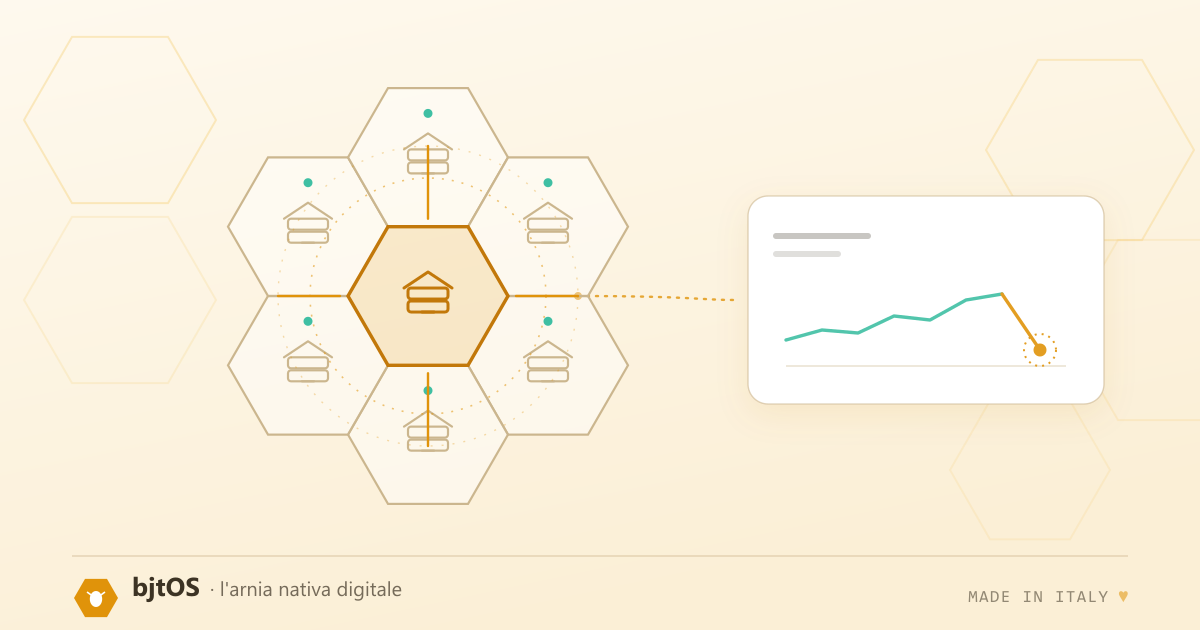
“Precision beekeeping” is one of those expressions that sound good in a headline and risk meaning nothing. I hear it used to sell everything, from the simplest sensor to the most complicated software, and I understand the experienced beekeeper who rolls their eyes at that point. And yet under the word there is a concrete and honest idea, worth pulling out of the jargon. I want to tell it to you the way I understand it, while I build bjtOS: not as a fad, but as a different way of standing alongside the bees.
What it is, put simply
Precision beekeeping is, first of all, a way of making decisions. Instead of working only on the average (all hives treated the same way, all visited on the same day, all managed “the way it has always been done”), it uses the data from each individual colony to act where and when it is really needed. The term is borrowed from precision agriculture, the kind that doses water and fertiliser metre by metre instead of across the whole field. Carried into the apiary, the idea becomes: listen to each hive as an individual, and adjust your work to what that hive is actually saying.
Put like this it seems obvious, and in a way it is: the good beekeeper has always done it, by eye and with experience. The difference is continuity. You stop by the apiary once in a while and photograph a single moment; the sensors, instead, watch the whole time, even at night, even on the days when you cannot get up there. Precision beekeeping does not add an eye better than yours: it adds an eye that never tires and never leaves.
It is not automation, and it replaces no one
Let me clear the field right away of the most dangerous misunderstanding, because it is the one that angers those who know the craft. Precision does not mean automation. No sensor decides for you, no algorithm opens the hive, assesses the combs, smells a diseased brood or judges whether a queen is young and fertile. All of this stays craft, hand, nose, eye: your stuff, that no data replaces.
What the data does is more modest and more useful: it tells you where to look. It turns a vague question (“how are the hives doing?”) into a targeted one (“why has number seven stopped gaining weight for five days?”). It is the same amount of experience applied to a more precise target. I tried to explain this difference, between the deluge of raw numbers and the summary that counts, when I described how a smart hive works: the intelligence is not in measuring a lot, it is in saying little and at the right moment.
The data that really counts
Precision beekeeping does not need a thousand parameters. A few, well chosen, are enough, because each tells a different chapter of the same story.
Weight is the colony’s diary: it climbs a few hundred grams a day and there is nectar coming in, it stays flat and the flow has stopped, it drops in winter as the stores are consumed, it crashes suddenly in the middle of the season and that is often a swarm. It is the richest signal of all, and I told it separately in reading the hive scale day by day.
The climate of the nest, temperature and humidity, tells you whether the internal machine is running: the bees keep the brood stable between 34 and 35 degrees Celsius with a stubborn precision, and when that value slips away for no reason something in the colony is wrong. Sound is the colony’s voice, which changes in the days leading up to a swarm or when it loses the queen. Flight at the entrance, counted by a sensor, measures in a direct way the strength and activity of the colony.
Four windows onto the same hive. Taken together, and watched over time, they draw a profile of each colony that by eye, from visit to visit, you would struggle to keep in mind across dozens of hives.
What really changes in the work
Here is the point that interests me, because technology that does not change a working day is just a gadget. Precision beekeeping changes three very concrete things.
The first: fewer wasted visits. Much of the driving a beekeeper does only serves to discover that everything was fine. If you know from home which hives are quiet and which are not, you go up when it is needed and head straight to the problem. It is not laziness, it is respect for your time and for the bees, which every opening disturbs.
The second: getting ahead. Many situations are discovered too late, at the next visit, when the swarm has already left or the colony has already run out of stores. A signal that arrives the moment the phenomenon begins gives you the days of lead time that make the difference between preventing and chasing.
The third, the most subtle: learning. A season that has been recorded is a season you can go back and study. Why did that apiary yield twice as much as the other one? What happened to the weight in the week the weather changed? The data does not hand you the ready answer, but it gives you back the right question, and on that your experience works much better.
Precision without complicating your life
There is a risk I always keep in mind, and it is that “precision” becomes a synonym for “complication”. A system that buries you in charts, that has to be recharged every week, that forces you to become a technician instead of a beekeeper, has failed, however precise it may be. True precision beekeeping has to disappear into the background: measure quietly, power itself with a solar panel, send the data even where the phone has no signal, and make itself heard only when there is something to say.
That is why, when I think about bjtOS, precision is not the number of sensors: it is the quality of the few things that reach you. A digital native hive, with measurement designed in from the drawing board and not stuck on top at the last moment, is the way I have chosen to make precision light instead of an extra burden. If you want to see how the chain works, from the sensor all the way to your phone, I have put it on the technology page.
Precision beekeeping, in the end, does not promise to make the bees easier. It promises something more honest: that the next time you go up to the apiary, you get there already knowing where to look.