How a Smart Beehive Works, Explained Well
How a smart beehive works: sensors, radio and an app that tell you what is happening inside the hive without opening it. No jargon, no magic promises.
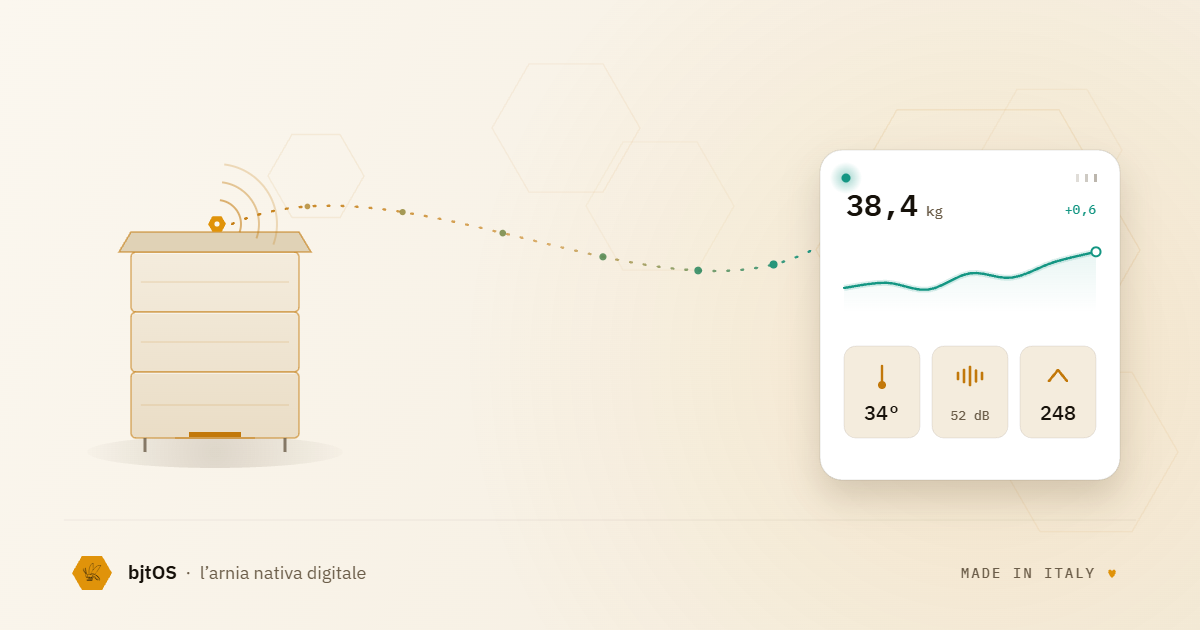
The question every beekeeper carries with them, while driving to the apiary, is always the same: what is going on in there? Does the colony still have stores? Is the queen laying? Has the honey flow started, or is everything at a standstill? To find out, there is usually only one way: get there, open up, look. And every inspection has a cost, in time for you and in disturbance for the bees.
A smart beehive tries to answer that question without making you lift the lid. In one sentence: it is a hive able to measure on its own some of the things happening inside and around it, and to send them to wherever you are. It does not read the colony’s mind, it does not replace your eye. It does something more modest and more useful: it listens continuously, even when you are not there, and warns you when something deserves attention.
It is worth understanding how it really works, piece by piece, because behind the word “smart” there is no magic: there are four simple jobs, lined up one after another.
The sensors: the hive’s sense organs
It all starts with the sensors, the components that turn a physical phenomenon into a number. In a smart hive they are few and well chosen, because each one tells a different chapter of the same story.
The first is weight. A hive scale, placed under the bottom board, weighs the box continuously: the weight curve over time is almost a diary. It climbs a few hundred grams a day and there is nectar coming in. It stays flat and the flow has stopped. It drops slowly in winter and that is the stores being consumed. And that sharp drop of a few kilograms in just a few minutes, in the middle of the season, is often a swarm leaving.
Then there is the climate of the nest: temperature and humidity. The bees keep the brood area stable between 34 and 35 degrees with surprising precision. When that value slips away for no reason, it is a sign that something in the colony is not working (a queen in trouble, a population too small to keep warm). Humidity tells the other half of the story, especially in winter, when too much condensation becomes the colony’s enemy.
There is sound. A colony has a voice, made mostly of low frequencies, and that voice changes depending on how it is doing: when it loses the queen, in the days leading up to a swarm, in the hours when something is unsettling it. A small microphone in the nest lets you listen to it continuously.
And there is flight: at the entrance passes the colony’s traffic, the bees going out to forage and those coming back loaded. A bee counter counts that coming and going and measures, in a direct way, the strength and activity of the colony. These are the building blocks of hive sensors: each one a different window onto the same hive.
From number to answer: intelligence on the spot
Here is the step that makes the difference, and that often gets skipped. A sensor, on its own, produces an avalanche of raw numbers: dozens of readings a minute, for days. Sending them all, just as they are, would make no sense: it would burn energy and bandwidth, and it would bury you under data you have no time to look at.
That is why inside the hive there is a small brain, an ultra low power microcontroller, that does a job of synthesis before it even speaks. It does not ship every single reading: it observes, averages, compares with the previous value, and decides what is worth saying. It sends the conclusion, not the deluge. “Weight stable at 24.3 kilograms”, “entrance quiet”, or, when needed, “drop of 1.8 kilograms in ten minutes”. It is the same difference as between a colleague who forwards you every email they receive and one who at the end of the day tells you the three things that matter. This kind of reasoned hive monitoring is what makes precision beekeeping sustainable in the field, and not just a nice laboratory exercise.
How the data reaches you, even without coverage
There remains the most concrete problem of all: apiaries are often where the phone has no signal. No wifi, no, sometimes, not even a single bar. How does the data get out of there?
The answer is a radio designed exactly for this: LoRa technology, which stands for long range. It is a radio that transmits very little data but far away, even for kilometres, while using a tiny fraction of the energy. It is a good fit precisely because a smart beehive does not have to send heavy video or photos: it has to send a few lines of summary, every now and then. The hive speaks over LoRa to a small receiver, a gateway, usually placed at a spot with a minimum of connectivity (a farmhouse, a barn, a raised point), and from there the message reaches the internet and finally your phone.
And the power? An isolated apiary has no electrical outlet. That is why the system is designed to live off-grid, off the network: a small solar panel charges a battery, and the consumption is so low that the hive can run for entire seasons without you having to think about it. It is a delicate balance between how much you measure, how much you transmit and how much energy you harvest: most of the design work sits exactly there. If you are interested, I have described how this chain works in detail, from the sensor all the way to the screen.
The alerts: the hive calls you only when it matters
Once the data arrives, the app or the dashboard does two things. The first, every day: it shows you the curves over time, so you see not only how much you weigh today but how you got there. The second, only when needed: it warns you.
This is the point that changes your relationship with the apiary. You do not have to be glued to an app checking graphs. You are the one who sets the thresholds that matter (a weight dropping too far, a nest cooling down, a fall in activity that does not recover), and the system keeps listening for you. When one of those limits is crossed, you get a notification: a possible swarm in progress, a colony at risk of running out of stores, a hive that moved when it should not have. The rest of the time, silence. A well made hive does not bombard you with messages: it calls you only when it has something to tell you.
What a smart beehive does not do
It is honest to say it clearly, because there is a lot of enthusiasm around these topics and one too many promises. A smart beehive does not replace the beekeeper. It does not know whether the queen is really young and fertile, it does not see the state of the combs, it does not smell a diseased brood, it does not make decisions for you. All the craft, the experience, the eye: they stay yours.
What it does is give you an extra pair of eyes, always open, even on the days when you cannot get up to the apiary. It cuts wasted visits, it helps you arrive prepared, it flags in advance the situations you would otherwise discover too late. It is not a replacement: it is a silent ally. The decision, always, is yours to make.
A hive designed, from the start, to tell its story
There is a consequence in all this, and it is the reason I am carrying bjtOS forward. If a hive has so much to say, then the technology that listens to it should not be a sensor stuck on top at the last moment. The scale, the microphone, the probes, the radio should be part of the hive from the design stage, at the service of the bee and of the person caring for it, without distorting the object the beekeeper already knows and trusts. It is the idea of a digital native hive: not a hive full of gadgets, but a hive designed from the start to tell its own story. If you want to see what shape it is taking, I have gathered it on the page dedicated to what we are building.
But now I am interested in your experience. If you work with bees, which of these signals, in your view, really counts enough to be worth a sensor, and which one is more noise than substance? It is exactly the kind of conversation this project wants to start from.