Beehive anti-theft: how to protect isolated apiaries
A serious beehive anti-theft system is not a siren: it is knowing right away that a hive has moved. How an accelerometer, a hive GPS tracker and geofencing protect isolated apiaries, and why I want anti-theft for beehives without a subscription.
There is a phone call no beekeeper wants to get, and it usually comes early in the morning: you have just reached the apiary and some hives are missing. Not knocked over, not damaged: gone. Loaded onto a van during the night and carried off, colony, honey and a whole season of work all at once. In Italy an estimated twenty thousand hives disappear this way every year, and theft almost always strikes where it hurts most: the isolated apiaries, far from home, left unguarded precisely because the bees do well there. A beehive anti-theft system is born from this very concrete pain, and for me it is one of the reasons a smart hive makes sense even for someone who does not want charts about their honey, but only wants to sleep soundly.
The point, though, is to understand what an anti-theft system on a hive can really do, and what it cannot. Because here easy promises are everywhere, and an experienced beekeeper picks them apart in two seconds. I want to tell you straight: how the protection I am building into bjtOS works, where the honest limits are, and why I decided from the start that this feature should not cost you a subscription.
An anti-theft is not a siren, it is an alert that arrives in time
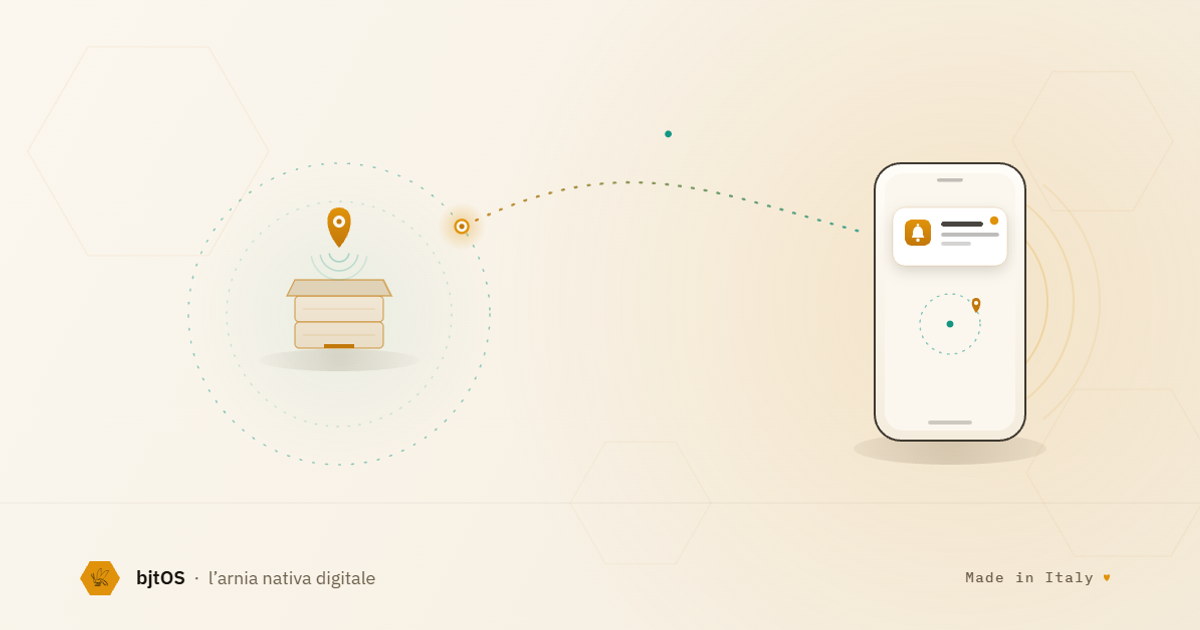
Let’s start with a common misunderstanding. When you say “anti-theft” the mind jumps to a siren that screams and scares off the thief. On a hive, in a field, miles from the nearest house, a siren is useless: nobody hears it, and the thief knows perfectly well there is all the time in the world. The real protection of an isolated apiary is not to frighten, it is to know. To know, the instant it happens, that a hive has moved when it should not have. That minute of head start is everything: it is the difference between a notification that wakes you while the van is still in the area and the bitter discovery at the next visit three days later, when the hives are already far away and unrecognizable.
So the whole anti-theft revolves around a single question: how do I notice the movement at the exact moment it happens, and get that alert all the way to where you are? The answer lies in three sensors that work together, each with a precise job.
The three sensors standing guard
The first, and the most important, is an ultra-low-power accelerometer, fixed firmly to the body of the hive. It is the sentinel that never sleeps. It lives in a resting state that draws a few microamperes, yet stays sensitive to movement: if someone lifts the hive, tilts it to load it or makes it sway, the accelerometer notices and instantly wakes the rest of the system. It is the main trigger, the one that sets everything off. A simple tilt past a certain threshold, or a jolt, and the hive understands that something abnormal is going on.
The second is a GPS receiver, and here there is a design choice that matters. GPS is the thirstiest sensor of all: if I kept it always on, it alone would drain the battery in a few days, making impossible the autonomous solar power that is the heart of bjtOS. That is why it stays off almost all the time. It turns on only when the accelerometer raises the alarm: at that point the node powers up the GPS, waits for the fix, that is the position, and attaches it to the alarm message. So you do not just know that a hive has moved, you also know where it is the moment the alert goes out.
The third is a humble magnetic contact, a reed switch on the lid. It draws practically nothing and is there for an event different from the theft itself: the opening of the lid. It tells you if someone has lifted the roof, whether that is a curious passer-by, a thief or you yourself during a visit. Precisely because it is often you, the opening has to be handled intelligently: you need an inspection mode that silences the alarm while the beekeeper is working, so as not to turn every visit into a false positive. It is one of the details I am still tuning in the field.
Geofencing: the hive knows its home
There is a feature that ties the accelerometer and GPS together and I find it the most elegant of all: geofencing. The idea is simple. At installation the hive stores its “home” coordinates, the precise point where you set it down. From that moment, if the position drifts beyond a preset radius, the alarm goes off. It does not matter how gently the thief loaded it: the moment it crosses the invisible boundary you have drawn around the apiary, the system knows.
It is a fence you cannot see and cannot climb over, because it sits not on the ground but in the position of the hive itself. And it combines with the movement trigger to cut down false alarms: a hive nudged half a meter by the wind or by an animal is one thing, a hive leaving the field is another. The logic can tell the two cases apart and wake you only when it really counts.
The honest limit of LoRa (and why I say it plainly)
Here I have to be honest, because I prefer an informed customer to an inflated promise. bjtOS transmits over LoRa, a long-range, ultra-low-power radio, perfect for carrying data from an apiary with no phone signal all the way to a small connected receiver. It is the right choice for everyday monitoring. But for anti-theft it has an intrinsic limit: if the hive is carried out of radio range, the following messages no longer arrive. LoRa is not a satellite tracker that follows the van down the motorway.
The mitigation lies in the timing: the alarm goes out immediately, the instant of detection, when in all likelihood the hive is still sitting in the field or has only just been lifted, and therefore still in range. That first message, with the home coordinates and the exact time, is what counts: it reaches you right away and tells you a theft is under way, now. For continuous tracking beyond range you would need a cellular fallback, a dedicated SIM: it is an evolution I will consider, but I do not want to sell you today something that is not there. Better an anti-theft that wakes you in time than one that promises to give chase and then goes silent.
Why I want it without a subscription
Most of the beehive anti-theft systems on the market run over the cellular network: each hive has its own SIM inside, and to keep it active you pay a subscription to a phone company, a monthly or yearly fee just like the one on your mobile. The day you stop paying, the operator deactivates the SIM and the hive goes silent again. I find it the wrong model for an object that has to last years in a field: basic protection, noticing that a hive moves and warning you, should not depend on the bill of a phone company.
The architecture of bjtOS is built precisely for this. The data does not travel over the phone network, but over LoRa, a long-range radio, to a receiver that is yours; from there it reaches the platform with a single connection, shared by all the hives in the apiary. No SIM inside every hive, and so no phone subscription multiplying by the number of colonies. It is one of the reasons I wanted a digital-native hive instead of an accessory to glue under any old hive: when security is part of the design, and not a service resold by an operator, it can also be part of the price, once.
Part of the hive, not a patch
As with the scale, here too my conviction is that good anti-theft is not a box added at the last moment, with its magnet that comes unstuck and its battery to replace. The accelerometer standing guard is the same sensor that one day will be able to read the vibrations of the colony; the GPS and the radio are already there for the rest of the telemetry. Bringing these pieces together inside the hive, right from the design stage, is what makes the protection reliable and almost free in terms of components, instead of a surcharge.
If you want to see how this protection fits into the full picture of the sensors, I have told it on the page dedicated to beehive anti-theft, and more generally in what we are building. And if you are interested in the thread that ties together all the hive’s data, from weight to sound, I have written about how a smart hive works as a whole.
So, how many calmer nights would it be worth to you to know, at the exact instant, that your hives are still where you left them?