Counting varroa with a photo: the optical varroa counter of bjtOS
Counting varroa by eye on the board is slow and error-prone. How bjtOS turns four photos of the tray into a mite-drop count, with alignment markers, a millimetre grid and mites per day.
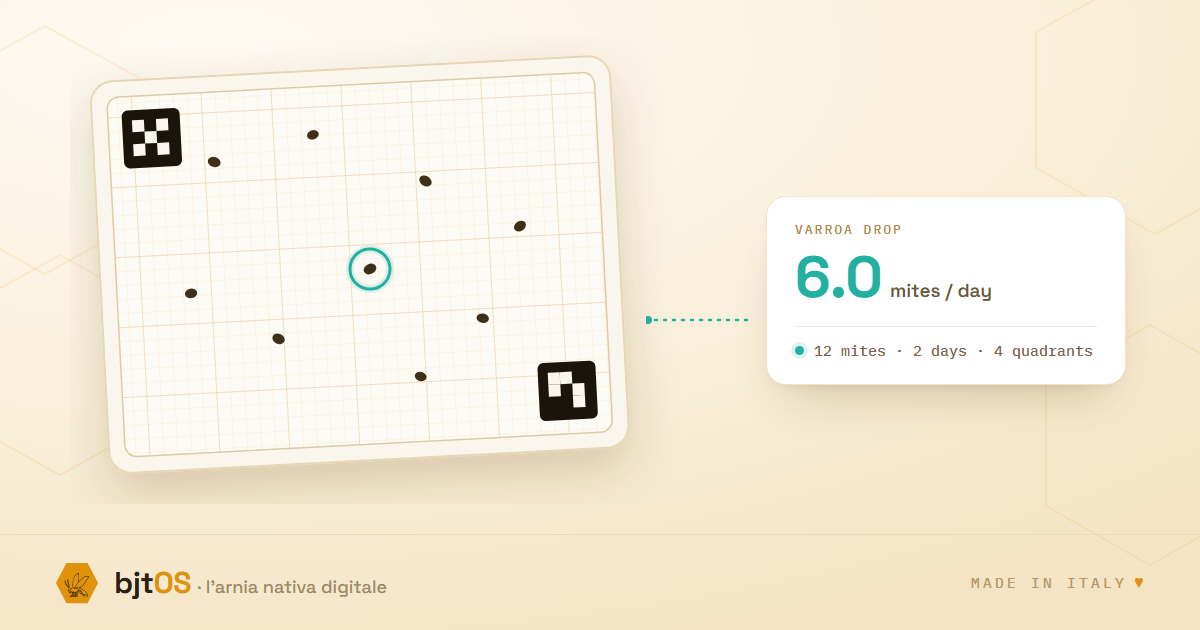
There is a chore every beekeeper knows and nobody enjoys: pulling the varroa board out from under the hive, laying it on a table, and counting the fallen mites one by one, head bowed, in just the right light. It is slow, tedious work, and precisely for that reason we tend to put it off or do it by eye. Yet that number, the natural mite drop, is one of the most important pieces of information a hive can give you: it tells you how strong the infestation is and, as a result, whether and when you need to act. Get it wrong and you treat too late, when the damage is done, or you treat when there was no need, stressing the colony for nothing.
Varroa is the leading cause of colony loss, and much of the season hinges on keeping it under control. That is why, when I started imagining what a digital-native hive should be able to do, varroa counting landed on the list early. Not to replace the beekeeper, but to take off their shoulders the most thankless and imprecise part of the job: counting by hand. The idea, in the end, is as simple as it sounds: take a photo of the tray, and let the system do the counting.
Why counting by eye is not enough
The natural mite-drop method is the most common precisely because it is cheap and non-invasive: you slide the diagnostic tray under the mesh floor of the hive, let a few days pass, and count the mites that have fallen on their own. Divide by the days and you get the daily drop, the famous “mites per day” you compare against a treatment threshold. On paper it is perfect. In practice, it runs into the reality of the tray: a dusty rectangle of wax, debris, grains of pollen and bits of cappings, among which the mites, barely more than a millimetre across, blend in all too well.
Counting them by eye takes time, good eyesight and concentration. And the result depends on who is counting, how tired they are, how much light they have. Two people on the same tray arrive at different numbers. And once the hives are ten, twenty, fifty, the temptation to “eyeball it” becomes irresistible, and eyeballing is exactly what makes monitoring unreliable. What was needed was a way to make that count fast, repeatable and the same for everyone.
Four photos, and the tray counts itself
The solution I am building in bjtOS starts from the tool every beekeeper already has in their pocket: the phone. You pull out the tray, which is already divided into four quadrants, and take one photo per quadrant from the app. Four shots, because a single glance from a distance loses the detail: by photographing it in pieces, at full resolution, even a one-millimetre mite stays legible. An on-screen guide tells you how to frame it, and no photographer’s precision is required: straightening things out is the system’s job, and that is where the most interesting technical point lies.
Nobody manages to photograph a tray perfectly square, at the same distance and the same angle every time. If the count depended on how you hold the phone, it would be useless. That is why the tray carries printed alignment markers, symbols at the corners that the system always recognizes, like the squares you see at the corners of a QR code. From those markers the software reconstructs the real geometry of the tray: it corrects the perspective, straightens the image and, above all, derives the scale in millimetres. It knows how big everything in the photo really is. It is as if every shot were mapped onto a precise millimetre grid, no matter how you took it.
On that rectified, scaled image, the algorithm looks for the mites, tells them apart from the debris and counts them, quadrant by quadrant. The result is the total and the drop in mites per day, computed over the days since you last cleaned the tray. A single number, obtained the same way every time, that you can compare against the threshold and line up next to last week’s.
A decision aid, not a verdict
Here I want to be honest, as I was about the anti-theft and the scale. The mite-drop count is an estimate of the infestation, not an absolute measure of the truth inside the hive. The threshold beyond which it pays to treat is not a number carved in stone: it shifts with the season, with the strength of the colony, with the kind of treatment you have in mind. What the varroa counter gives you is a reliable, repeatable figure to reason about, not a sentence. The decision to treat stays yours, with your experience and your knowledge of the apiary: the tool is there to give you better numbers, not to take away your craft.
There is also a piece of truth about where we stand. Recognizing the mites is the part I am calibrating right now, on the real trays of the beekeepers taking part in the pilot: every photo gathered, with its hand-verified count, teaches the system to better tell a mite from a fragment of wax. It is work that improves with the real data of people who keep bees, not in a lab. I would rather say it plainly: today it is an infrastructure that runs end-to-end and grows in accuracy with the pilot, not a promise of magic already perfect.
Part of the hive, not one more app
The last thing, and it is the thread that ties all of bjtOS together. The varroa counter is not a separate application to learn from scratch, with its own account and its own data living off on their own. It lives in the same platform where you read the weight, the brood-nest climate and the apiary’s alerts. The history of the counts sits next to that of the honey super: so varroa pressure and the colony’s trend read in the same place, side by side, and you start to see the relationships that the eye misses. And like everything else in bjtOS, it does not require a phone subscription per hive: it is part of the design, not one more service to pay someone for.
It is the same principle as the anti-theft protection and the scale: a good tool is not a box stuck on at the last moment, but a capability designed into the hive from the start. If you want to see how the scan works in detail, I have described it on the page dedicated to the optical varroa counter, and more generally in what we are building. And if you are interested in the bigger picture, varroa monitoring is one piece of what I call precision beekeeping: not automation that replaces you, but data that helps you decide better.
So let me ask you straight: how many evenings a year do you spend counting mites on a tray, and what would you do with that time if a photo were enough?