Why it's called bjtOS: a transistor, a bee and an operating system
Choosing a name for a project is harder than it looks. The one behind bjtOS hides three meanings that converge on the same object: the electronics, the bee and the system. And the ancient Egyptians had already gotten there.
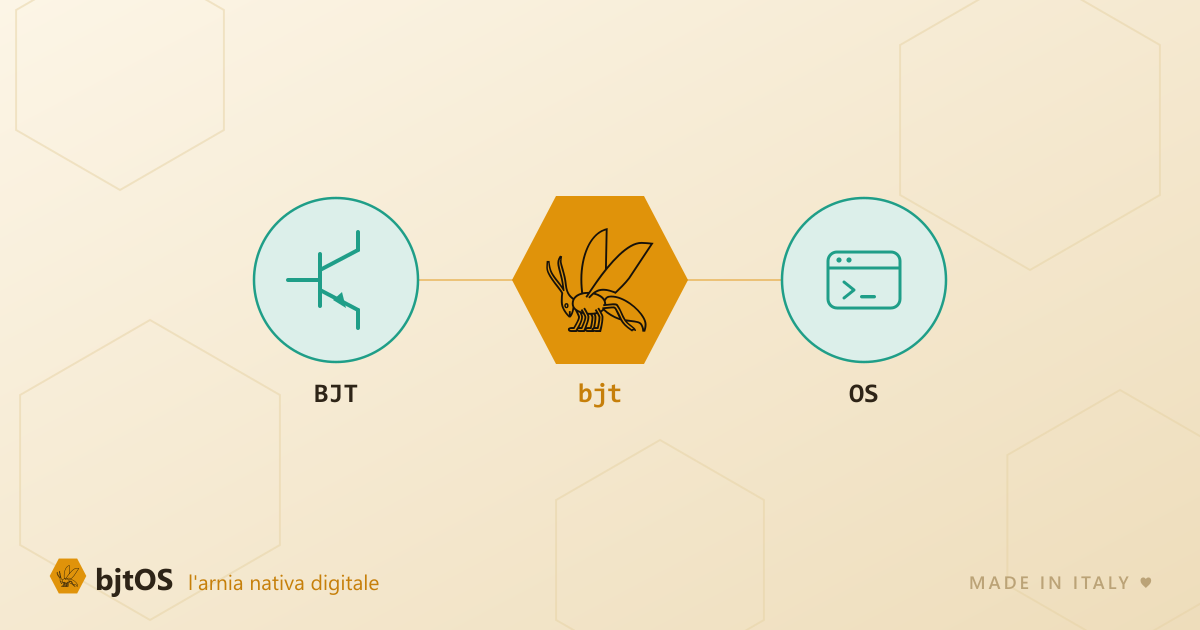
Of all the hard things in a project, one of the most underrated is giving it a name. You can spend months on the technical side and then get stuck for a week in front of a blank page, because a name has to do too many things at once: be short, say who you are, not be taken already, and ideally not make anyone laugh. For bjtOS it went in a way that still amuses me to tell, because I didn’t really invent the name: I discovered it one piece at a time, and in the end three different meanings ended up all pointing at the same object.
This is a light piece, without a single line of electronics. Just the story of three and a half letters.
BJT: the building block
The starting point was the technological side. “BJT” stands for Bipolar Junction Transistor: one of the most elementary and iconic components in all of electronics. It’s not a sophisticated chip, it’s a building block. It’s the kind of thing you study in your first year, that you draw a thousand times in a notebook, that lies at the foundation of almost everything that comes after.
I liked it precisely for that. bjtOS is not a flashy gadget, it’s an object built starting from the fundamentals: power, signal, reliability. I wanted a name that carried that sense of “we begin from the basics, done well.” A transistor is exactly this. If the project had a symbolic building block, that would be it.
So far, an engineer’s choice. Then I did something I often do when a name convinces me: I went to check whether those same letters meant something else, somewhere else. And here the story gets interesting.
bjt: the bee
“bjt”, in lowercase, is the transliteration of an Egyptian hieroglyph. And not just any hieroglyph: it’s the sign of the honey bee (𓆤, catalogued as L2 in Gardiner’s classification, the standard by which Egyptologists order the signs).
When I discovered it a whole world opened up, because in ancient Egypt the bee was not just any insect. It appeared in one of the pharaoh’s most important titles, nswt-bjtj, which translates roughly as “He of the Sedge and the Bee”: the sedge symbolized Upper Egypt, the bee Lower Egypt, and together they said that the ruler reigned over both. The bee, in other words, was a symbol of sovereignty, not of mere nature. And the same linguistic root intertwines with the words for honey. Bee and honey, royalty and sweetness, already knotted together in etymology thousands of years ago.
There’s something almost comic in realizing it: you spend weeks looking for a modern name for a technological hive, and you discover that a civilization five thousand years ago had already fused into a single syllable the bee, the honey and the idea of an order that holds things together. I didn’t invent it. I only rediscovered it.
And that’s why that bee didn’t end up only in the name. It became our logo: the amber hexagon we carry with us has that very hieroglyph inside it, the sign 𓆤. Not a bee drawn by a graphic designer, but the bee that the scribes traced on papyrus. If you look at the mark with this story in mind, you see it differently.
OS: the system
The last part remained, and it served to frame what we are really building. “OS” stands for operating system. It’s the word that sets bjtOS apart from everything else on the market.
Today, if you want a connected hive, you have two roads. Either you buy a traditional wooden box and stick sensors sold by someone else on top of it, treating the hive as a box taken for granted. Or nothing. Nobody starts from the idea that the hive itself is a device, with its own platform, conceived digital from birth and not electrified after the fact.
“OS” says exactly this. Not “a hive with some sensors”, but “a hive that runs on a system”. Digitally native, to use the formula I repeat most often. It’s a small word, two letters, but it shifts the whole center of gravity: from the accessory to the integrated product.
Three readings, one single object
What makes this name special, for me, is that the three meanings are not in competition. I didn’t have to choose which one should win. They converge.
The transistor is the electronics, the technical base. The bee is, literally, the subject: the honey, the colony, the object of all the work. The operating system is the ambition: to make the hive a platform, not a container. Electronics, bee, system. The same three letters read in three ways, and each reading says one true part of the project.
It’s rare for this to happen, and when it does you take it as a small sign that you’re on the right track. A name you have to explain with effort is usually a wrong name; a name that, the more you tell it, the more it opens up, is a name that works for you.
Why a name matters
You might think all of this is a quirk, that in the end a name is just a label. I don’t see it that way. A name is the first promise you make, the one that arrives before the product, before the demo, before any data on the screen. bjtOS promises three things in one word: that underneath there is real engineering, that at the center there is the bee and not technology for its own sake, and that the hive is conceived as a system, whole, from the start.
Now, every time someone asks me where the name comes from, I have a story to tell instead of an acronym to spell out. And a story, in a project that has yet to make itself known, is worth more than a slogan.
If you want to see what lies behind the three letters, I’ve told how a smart hive works and what it means to design it digitally native in the pages dedicated to the technology and to the product. If you were wondering why there’s an Egyptian bee in the logo and not just any bee, here’s the answer: it’s no accident.